

A story by Connie O'Connor on Stephanie Carlson. This article is also featured in the September 4, 2026, issue of The Ripple.
Click here to subscribe to this monthly e-newsletter!
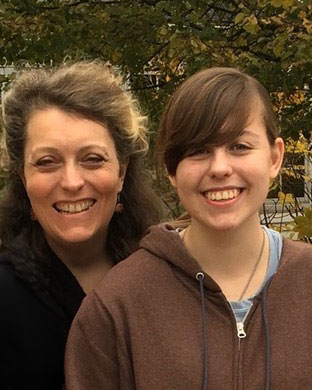
The Nature Center’s philosophy on “Conservation Civics” is that people need to connect with one another to solve complex societal problems such as those threatening our environment, natural resources, health, and wellbeing. Connecting with others requires us to be kind, empathetic, and helpful. These attributes are also needed in the world of wildlife rehabilitation, and so today’s article features wildlife rehabilitator Stephanie Carlson, a local resident who has been an officially permitted wildlife rehabilitator for the past 12 years. Her 501(c)(3) is located at her home and is called St Mel’s Wildlife Rescue.
Kindness has a ripple effect, and when we show it toward animals and toward the people who seek help to protect them, it reinforces the goodness within us and others. Stephanie spreads kindness in her volunteer efforts every day.
Edward O. Wilson coined the term “biophilia” to describe the innate fascination with living things born into most humans. For Stephanie, that biophilia was supported by the Jr Zoologist Club at Cincinnati Zoo back in the 80s, where they used to operate a “raise and release” program. At that time in her youth, Stephanie volunteered to help raise orphan native wildlife under the sub-permit held by the Zoo. In time, Stephanie was called to raise her own human family, putting wildlife on the back burner. That is, until 2013, when her neighbors brought an orphaned American Robin to her. It was found on the sidewalk “and was definitely in need.” That’s when she realized it was a felony to rehabilitate avians without a permit.
So began Stephanie’s quest to get the appropriate training and permits to make a difference.
She explains the process: “You start off as a Category 1 rehabilitator, typically by connecting with the Ohio Wildlife Rehabilitators Association, and that gives you the training to apply for the Ohio permit. Then it's time to build your cages or enclosures, and a wildlife officer will come out and inspect them. Then you get your approval for Category 1 which means you can legally help raise orphan and injured baby rabbits, Virginia opossums, and squirrels. Mammals are easiest to feed and need feeding less often, which is why new people start off with them. The next step is Category 2, and that allows you to help injured as well adult mammals too. You can then decide if you want to get training and a special permit for rabies vector species which are raccoons, foxes, skunks, and bats, or if you want to specialize in Category 2 avians, like I have. For birds, you need a Federal Fish and Wildlife permit."
Stephanie focuses on common backyard birds, such as Morning Doves, robins, and cardinals, along with some migrating species like Chimney Swifts, Cliff Swallows, and Barn Swallows. She takes anything crow-sized and smaller, except for hummingbirds, which she sends to her colleague Tracy Brewer at Ride the Wind Wild Bird Rehab Center.
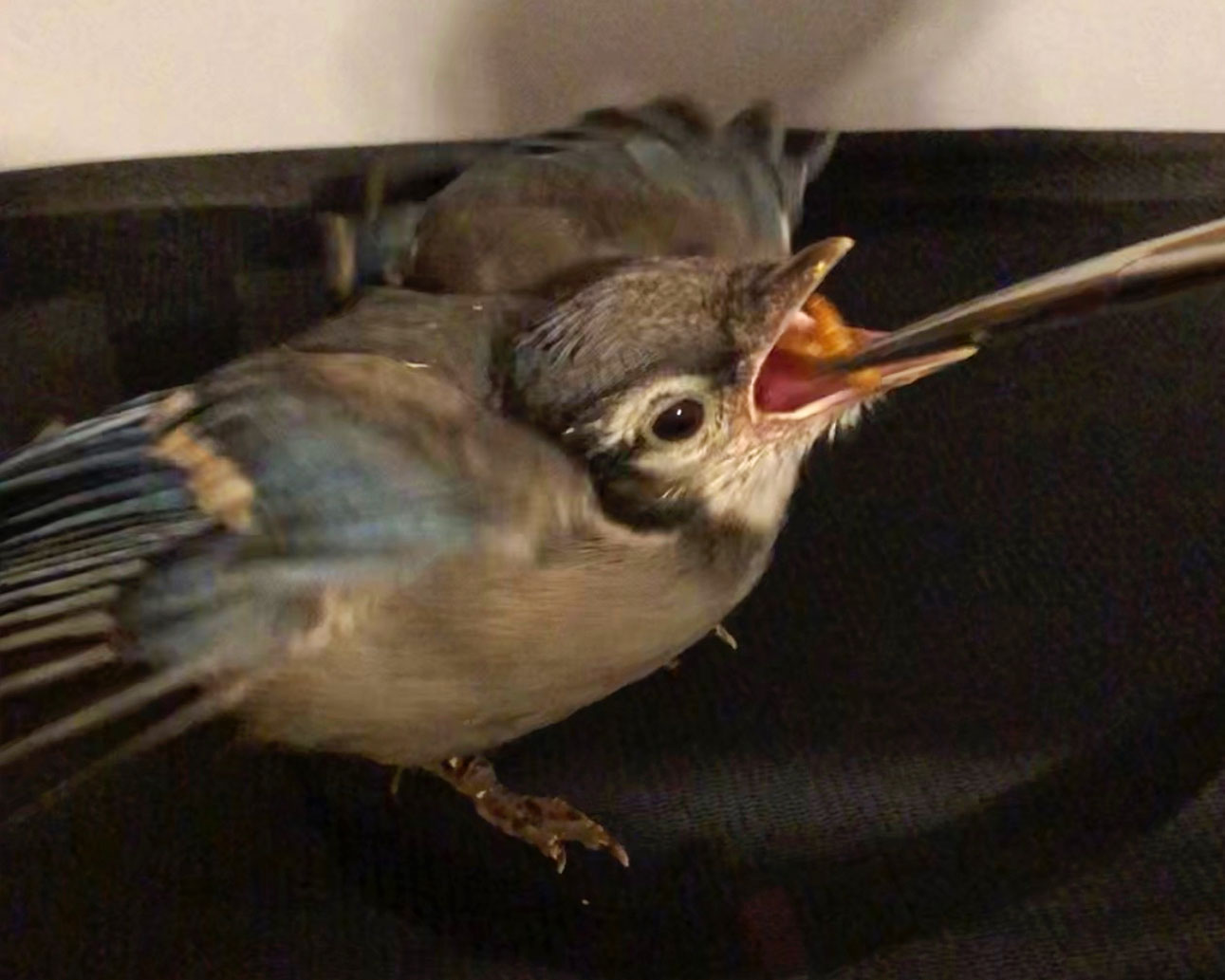
Stephanie emphasizes that each baby bird species has different feeding requirements … a baby bird is not just a baby bird. For instance, Mourning Doves are obligate granivores—the only insect they ever eat is by accident because their primary diet is grains. Other birds are obligate insectivores, and some of them, like Chimney Swifts, only eat while flying. Stephanie describes hand-feeding Chimney Swifts with tongs once they leave the nest. She waves insects around on the end of the forceps, and they will swoop down and pick them up. On the opposite extreme are Blue Jays which will eat just about anything, so she tries to get small little bites and different types of rehabilitation formulas into them. But, she explains, their intelligence makes them get too comfortable with humans which makes them hard to release, so it helps to wear a mask when interacting with them.
Since the diet is critical to their survival, it’s important to learn to identify nestlings.
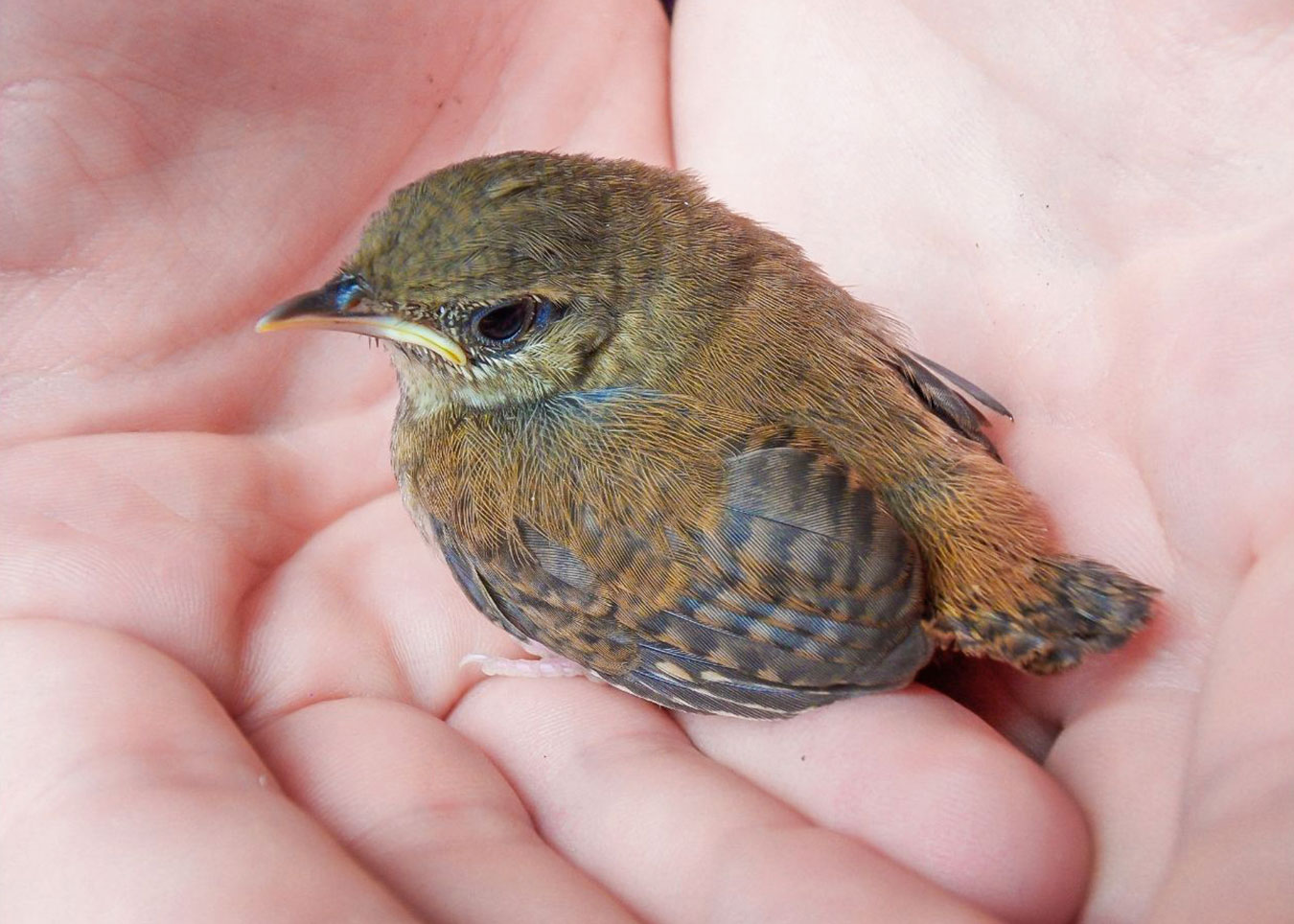
This is how Stephanie tells them apart: “Finches have little distinctive corn rows. Chimney Swifts are completely bald with weird little feet. Nighthawks are fuzzy, like a little chicken with a tiny black beak, and they have weird little feet too. You start to look at identifiers, like how many toes? What direction are the toes facing? How long is the beak? What shape is the beak? Sometimes you can tell by the color of their open mouths. You might not be able to tell the difference between a House Wren and a Carolina Wren until they start to grow a little bit bigger, when you'll notice the eye bands and colors once the feathers come in.”
Stephanie started off on the typical path by rehabilitating baby mammals. “I have raised squirrels, cottontails, Virginia opossums, even a mink. I tried my hand at box turtles for a while, but the more complicated cases I send to Tiny Wonders in Loveland or Arrowhead Reptile Rescue. I can handle some bird injuries like very mild breaks with no bones exposed. Sometimes their claws are clamped and I make little booties to help them learn to straighten out their feet. I can also treat air sac ruptures and mild diseases that don’t require a quarantine—like when baby Blue Jays and the Starlings had a vitamin A deficiency from their parents feeding them too many cicadas during the big emergence—a natural example of why it’s so important to get the nutrition right.”
Taking care of baby birds is exhausting and all-consuming.
Stephanie explains, “I’m busy sunrise to sunset between feeding and cleaning cages and enclosures. When they start to get a little bit older, you can go 30 minutes between feedings which is close to what their parents would have done in the wild. So feedings go from approximately every 15–20 to 30–45 minutes and after they fledge, it's like a game of ‘Marco Polo’ in their enclosures. In nature the baby robins will fledge before they can fly well, and they’ll be on the ground somewhere. Maybe mom’s got four baby robins, and so there's one over here and one over there, and one a few feet away hiding in the bushes. They're just saying ‘cheap, cheap, cheap, cheap’ and mom is rushing around feeding them. Except now I’m mom! But some birds, like Barn Swallows, Eastern Bluebirds, wrens, and phoebes aren't supposed to leave the nest before they can fly. They come out of the nest flying. So, if you see one of those guys on the ground, there's something wrong.”
Doves are unique to care for as well. Stephanie describes what's called crop milk—not like mammal milk but a grainy type of pre-digested food secreted in the crop. She describes “When dove babies eat, the parent will open its beak and it looks like they're swallowing their baby's head. Then the baby guzzles a little bit. As they get older, they will start producing a combination of crop milk and pre-digested seed bits and eventually the baby will just get seeds.”
What keeps Stephanie going when the days are hard and long and there are so many little mouths to feed?
She explains, “It really is hard to choose which animals to care for because I enjoy all wildlife, even down to the little insects, which probably rubbed off a little bit on my daughter Charlotte who works at Cincinnati Nature Center. I really enjoy rehabbing birds because of the challenge—there's so many different things that can go wrong but it feels so great when I have a successful release. There's just something that calls to my soul with birds. They are such an important part of our ecosystem … when the skies go silent, then we'll know we’ve got a problem."
"I do feel that each species has a place in the connected web of life, even something common like a robin. And we shouldn’t take even common birds for granted because you never know when they might disappear—with the problems insects are facing, and pollution and weather changes. People took the Passenger Pigeon for granted and look what happened—now they’re extinct. Amazing living things don’t have to be exotic or rare. There is beauty and awe in the common too. And no saved life is waste of time from the perspective of the animal, no matter how abundant the species. It’s the best thing ever to release a bird that you've raised from a nestling and now it's an adult and you're sending it on its way. That is what keeps me going."
“I feel that my efforts are a service for animals, and also a service for the people because they are often very, very passionate and very scared. They say ‘Oh, this poor animal is going to die.’ Sometimes people are more sensitized to the suffering of an animal if they have experienced a recent loss in their lives, and they’ll say they just can't stand to see this little creature die—please help. And sometimes the interaction ends in hugs. I feel this volunteer work is community service and connects me to people from all walks of life, all creeds, all races, all socioeconomic status. The common thing is they want to do what's best for that animal that they found.”