

A story by Connie O'Connor on Cheryl Vargas. This article is also featured in the January 9, 2026, issue of The Ripple.
Click here to subscribe to this monthly e-newsletter!
Cheryl Vargas never planned to get involved in conservation civics but is refreshingly open and candid about her backstory. This retired doctor has been sober for 20 years and has a deep love of learning. She’s dived into topics as diverse as entomology, knitting, microbiology, and philosophy.
One day she thought she’d like to learn more about gardening.
She says, "I love gardening because it's like painting with plants… the different layers, textures and colors." But while looking into the Master Gardener Program offered though OSU Extension, a different program caught her eye—the Ohio Certified Volunteer Naturalist (OCVN) Program. "It sounded right for me,” she explained, “I love science and could learn more about natural history and how everything is connected... the interrelationships in nature."
Her interest in gardening and in ecosystems came together during the OCVN course, when she discovered that her home landscaping was "conventional,” meaning it was comprised of non-native plants that local animals did not recognize as food. She exclaims, "These plants might as well be made of plastic. I mean, they looked beautiful, but nothing could eat them—it wasn't helping anything to survive. I realized I'd been doing it all wrong.”
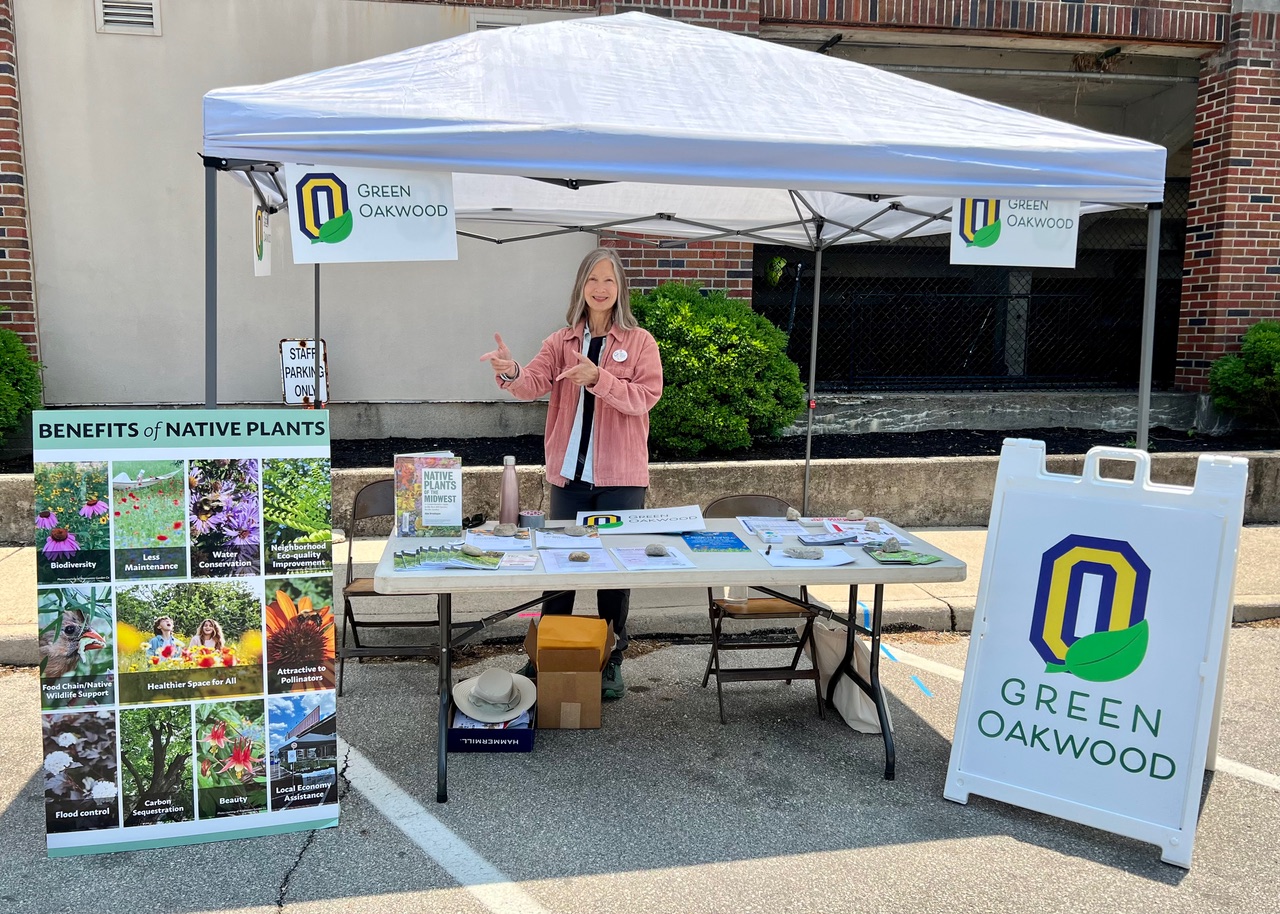
Cheryl's passion for native plants continued as she took more courses, joined native plant clubs, and attended a talk by Doug Tallamy, author of Bringing Nature Home. She found kindred spirits in her city’s “Green Oakwood” group—residents working to raise awareness of sustainability issues, share information, and help provide opportunities to protect and enhance the natural environment in her Dayton suburb of Oakwood. Originally focused more on recycling, the group added a biodiversity committee, and Cheryl became the chair. She volunteers to make and provide mosquito buckets at the local farmers market—an effective and safe method of mosquito control that doesn’t kill beneficial insects. She also plays a role in her local Wild Ones chapter and the Midwest Native Plant Society while creating and maintaining a native shade garden at her local library. Here, visitors find inspiration to add natives into their home landscapes.
But soon she learned that it’s not enough to inspire people to plant natives if their ordinances forbid it.
She explains, “Going to city hall wasn't my thing, but I read the ordinance for landscaping for the city of Oakwood.” She realized her ironweed, which feeds butterflies, was illegal. The ordinances were created years ago and defined many beautiful native plants as weeds. So, her first foray into civic action was when she and a peer spoke to zoning staff. “I just called and said, ‘I want to talk to you about something about the weed ordinance for the city.’ They set up a time, and I presented research on native-plant friendly ordinances from other Ohio cities and how these plants are beneficial. I explained that Oakwood needs to be more forward-thinking regarding landscaping—properties can be both beautiful and support nature. They asked some questions, I showed them pictures of gardens and plants, and gave them examples of ordinances… it was a good conversation.” Cheryl also wanted them to put something in the ordinances to encourage Oakwood citizens to protect biodiversity through their landscaping, as many Oakwood properties have conventional lawn and ornamentals. But that idea didn’t go anywhere.
Cheryl sent a thank-you letter and offered her help if they had further questions. She didn't hear anything for months and assumed they were not interested in changing anything. Then an email arrived with their first draft of a revised ordinance for her review prior to an upcoming council meeting. She spoke with her contacts at the groups she had joined and then went to the city council meeting where the ordinance was read for the first time. “I was shocked that they made some considerate changes” she said. “One person can actually initiate city change!” And while they wouldn’t add a pro-biodiversity decree like some cities have, nor add rules about pesticides, they did add an introduction that mentioned the environmental benefits of native plants and they changed the title from ‘weed ordinance’ to ‘landscape management.’ She was happy with the outcome.
People will sometimes ask Cheryl for help with their native plantings. She is quick to emphasize that people must choose their battles and be realistic about what to ask for, and how to fit into the norms of their community.
“As things stand, prairie front yards won’t work in our city. We need planned, intentional, maintained and trimmed borders, not plants falling over onto the sidewalk.”
Cheryl tries to help—both in her city and in neighboring communities.
For instance, a family in the Dayton suburb of Beavercreek had spent a lot of money and time making their whole front yard a beautiful woodland. There were native wildflowers under the trees yet bottle brush grass was flopping over onto the road. The city of Beavercreek ticketed them and told them rip most of it out. But the family had read the ambiguous ordinances differently. Cheryl tried helping them tidy up their yard. “I said, your plants are great, but we need to make this look more gardened, more intentional. Pay attention to color, texture, and how the eye travels—this can be beautiful and organized”. She advised them to file an appeal which extended their time to make things right.
Following the appeal, Cheryl, some Dayton Area Wild Ones (DAWO) members, and a grassroots group of citizens proposed a new landscape ordinance for Beavercreek which would be more friendly to native plantings. Drawing from her experience with Oakwood, she helped prepare a presentation for city administrators, discussing the importance of native plants and addressing their concerns.
A fellow DAWO board member and Beavercreek resident spoke at a city council meeting. She used the kinds of communication techniques that Cheryl knew about from taking Cincinnati Nature Center’s The Ripple Effect Course. She gave the city board credit, was kind, acknowledged the many perspectives they need to balance, spoke nicely and with respect. She acknowledged that they all want their kids to have fun and be safe, and they probably enjoy fireflies. She explained that native plants won’t attract rats and snakes, can be pretty, and can attract butterflies, fireflies, and songbirds. Overall, the city council was not won over and expressed strong preference for the aesthetics of extensive lawn—turf grass, boxwood along the foundations, conventional plants separated by mulch.
In the end, they made just a few changes. Cheryl said, “It was pretty disappointing. They insisted on having in their ordinance that only 50% of your front yard may be gardens—the rest has to be less than 6 or 8 inches. So basically—turf grass. They initially wanted 70 or 80% turf grass, so 50% was better at least. But it's not what we hoped for. It's not as much as what Oakwood did. At least they’ve grandfathered in front yards that are gorgeous but more than 50% gardens. So that was a partial win.”