Cincinnati Nature Center | Public Programs Manager
October 13, 2026
Tags:
Foraging
Acorns
Growing Up in Nature
A story by Public Programs Manager Jason Neumann. An excerpt of this article is also featured in the October 14, 2026 e-newsletter, Now in Nature.
With my wandering vacation mind, I’d been contemplating the circuitous life experiences that had led me to a long career as a professional teaching naturalist with a serious lean into creating foraging and farmed native plant programming at Cincinnati Nature Center.
One early memory seemed significant.
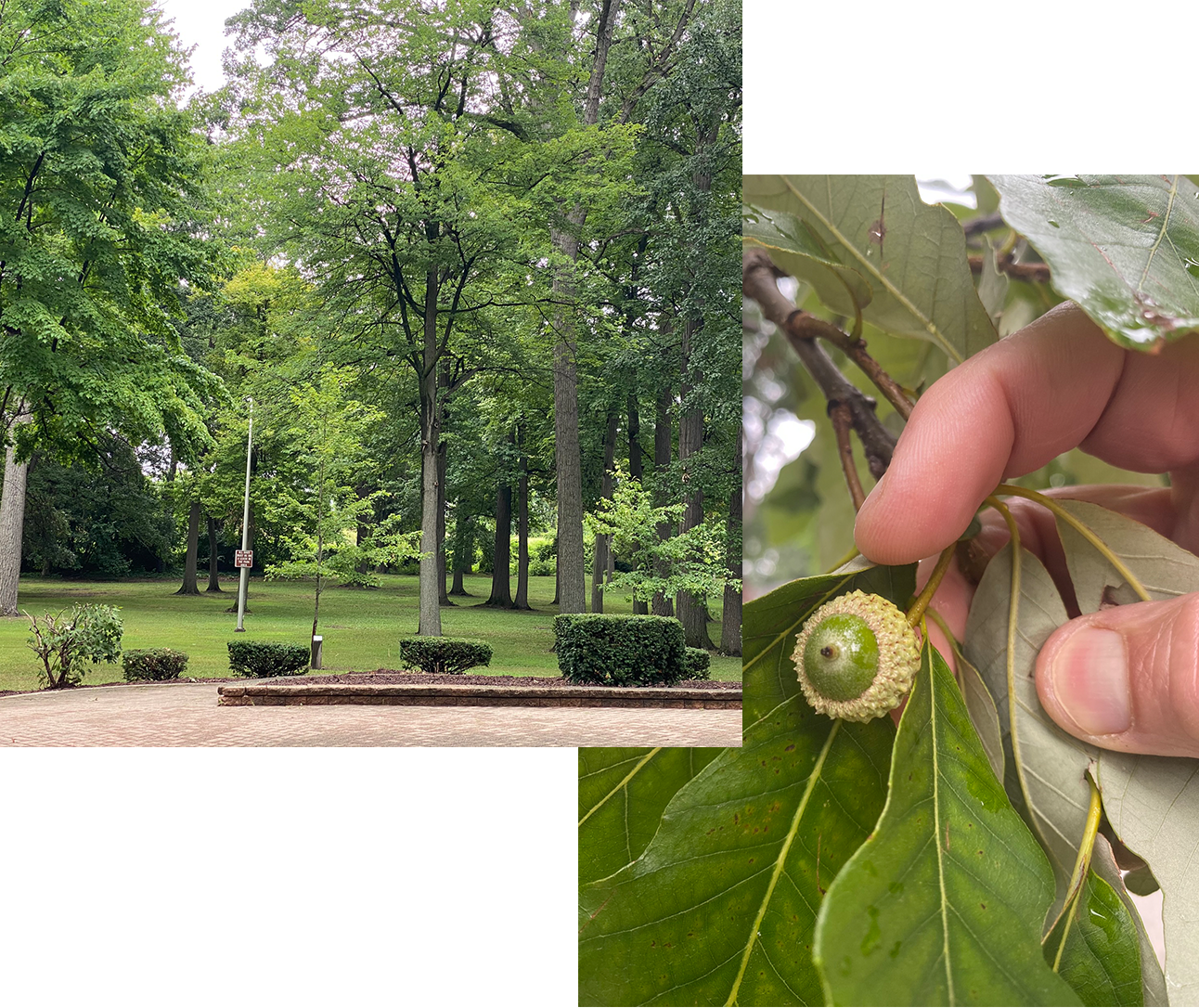
I recalled a time when I was about 6 years old, when life seemed simple. We lived directly across the street from a park. I distinctly remember picking up acorns that seemed as big as my hand. Now, some 50 years later and with decades of natural history work under my belt, I thought, “I bet those were bur oak acorns” and I was drawn to go find them.
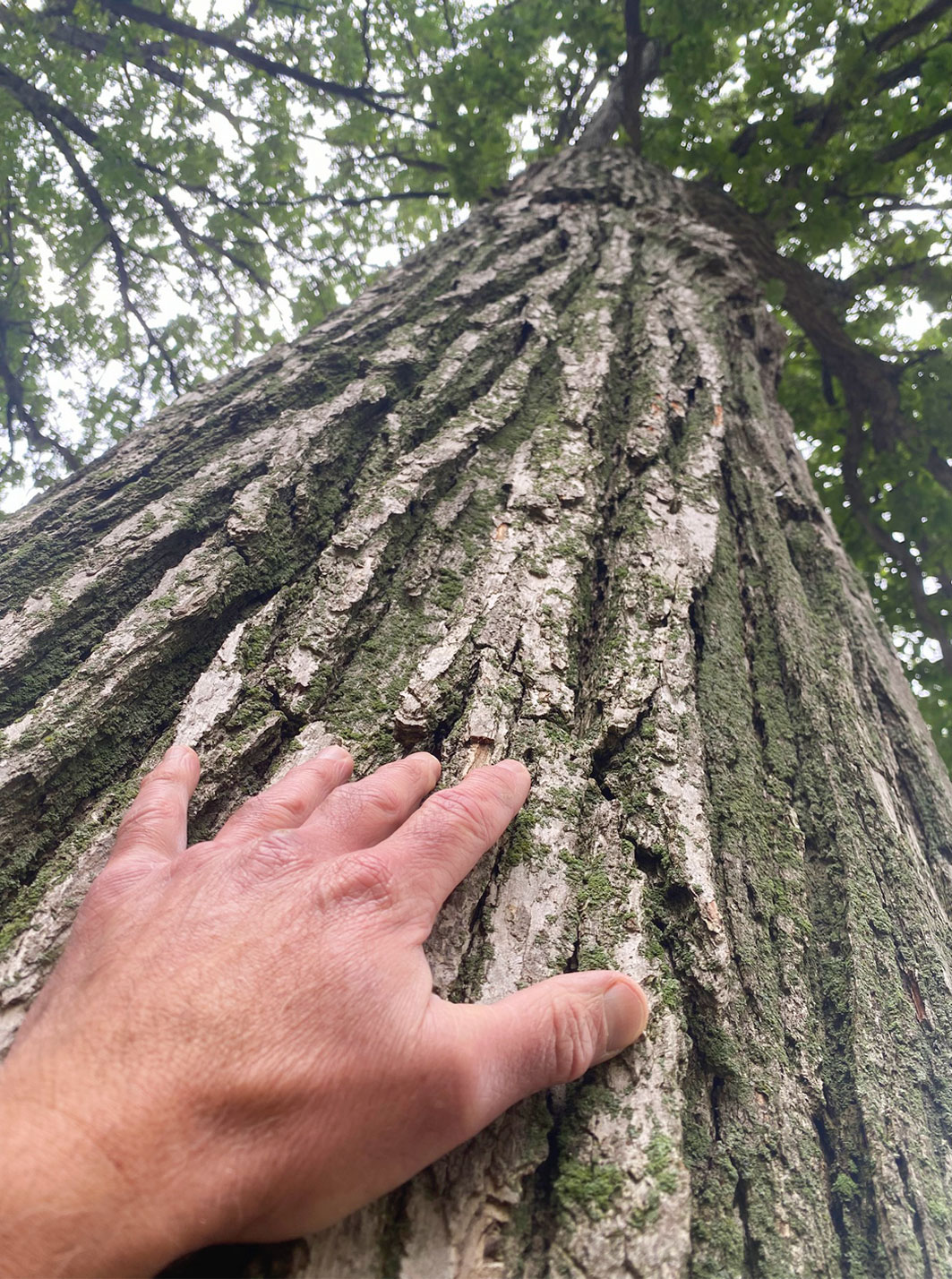
I GPS’ed directions and got off the highway. I parked the car, climbed out and started looking through naturalist eyes. This park had been well cared for over the years…there were many kinds of oak trees of varying ages. I found one young bur oak (Quercus macrocarpa), then another. I wandered around looking at leaves, touching bark…and then I spotted an oak tree whose massive size clearly indicated it was one of the trees I had played under 50 years ago. I reached up to put my hand on the trunk as if to say, “Hello old friend, thank you for the early inspiration.”
When I was about 6 years old, my family lived directly across the street from a park. I distinctly remember picking up acorns that seemed as big as my hand. | Photos by Jason Neumann
“Hello old friend, thank you for the early inspiration.” | Photo by Jason Neumann
A flood of other inspirations came to mind...
…of forestry classes in high school and college and how recent classes in agroforestry that blend farming with trees have fueled my interest.
…of how acorns and oak trees inspire a love for nature.
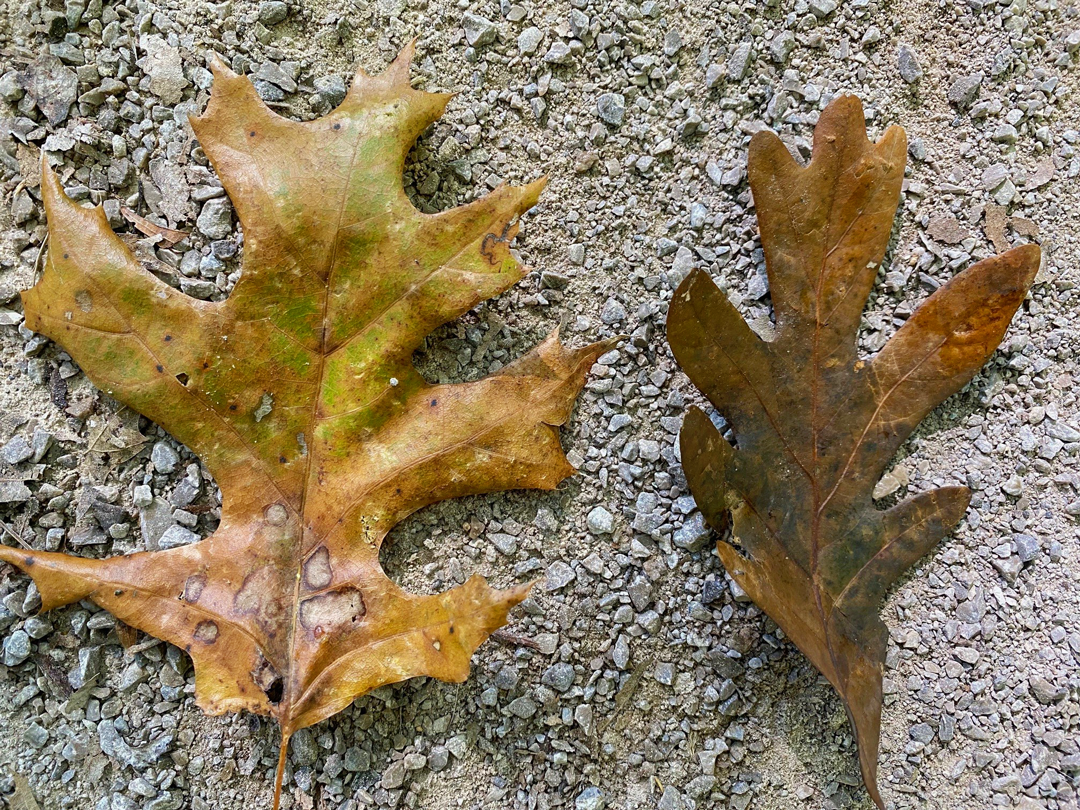
My 7th grade leaf collection further spurred my love of trees. That was the first time I remembered hearing how to tell red oak (Quercus rubra) vs white oak (Quercus alba). See photo caption below for more details.
Red (left): pointy like fire; White (right): round like clouds. | Photo by Jason Neumann
Acorns are significant in early childhood.
Trying to make sense of what seemed like a significant memory of acorns…I had asked the Nature Center’s preschool director, Tisha Luthy, if she could explain my acorn memory and delve into the importance of acorns in early childhood. Tisha enlightened me:
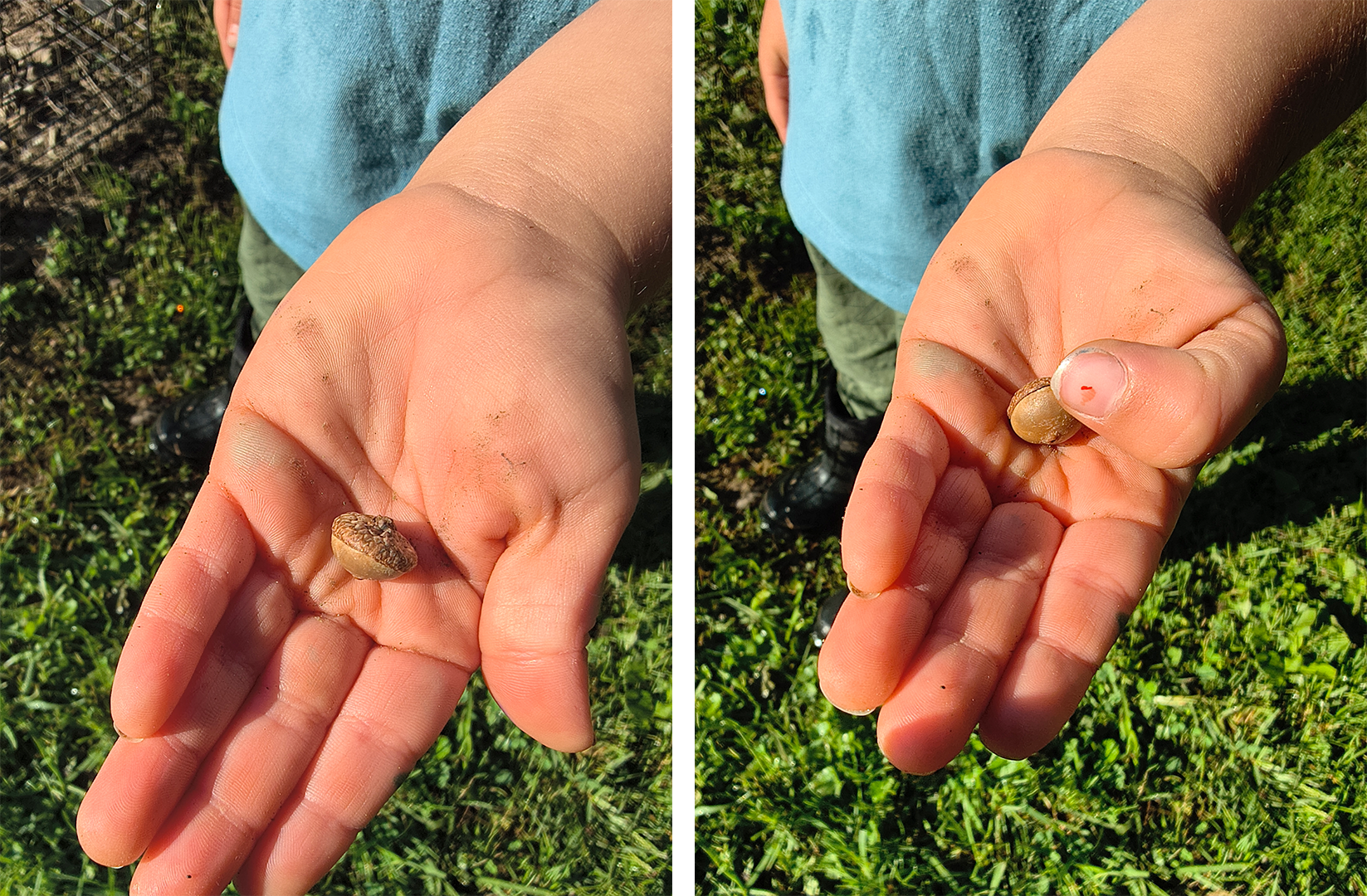
“Acorns naturally invite children to pick them up, examine them, compare their sizes and shapes, collect them, sort them, and wonder where they came from. What may seem like a simple acorn to an adult can become a treasure, a family, or the beginning of a much bigger question about trees, animals, seasons, and how things grow.
Experiences like collecting acorns help children develop a sense of connection and belonging in the natural world. When children are given the time and freedom to explore nature, they begin to notice small details like tiny holes and develop curiosity. Those repeated, hands-on experiences can become the memories that stay with them for years.”
From Nature Preschool: "Look what I found this morning..." | Photo by Tisha Luthy
Those small holes lead to another lesson: acorns are food and part of a dynamic, living food web.
With children, we sometimes explain that acorns are food for baby trees.The oak tree created a lunch box (the stored food inside the acorn) and a rain coat (the acorn shell) for each acorn. To help preserve the stored food, a protective preservative (tannin) has been incorporated into the acorn; tannin plays a significant role in the life of acorns/ acorn story.
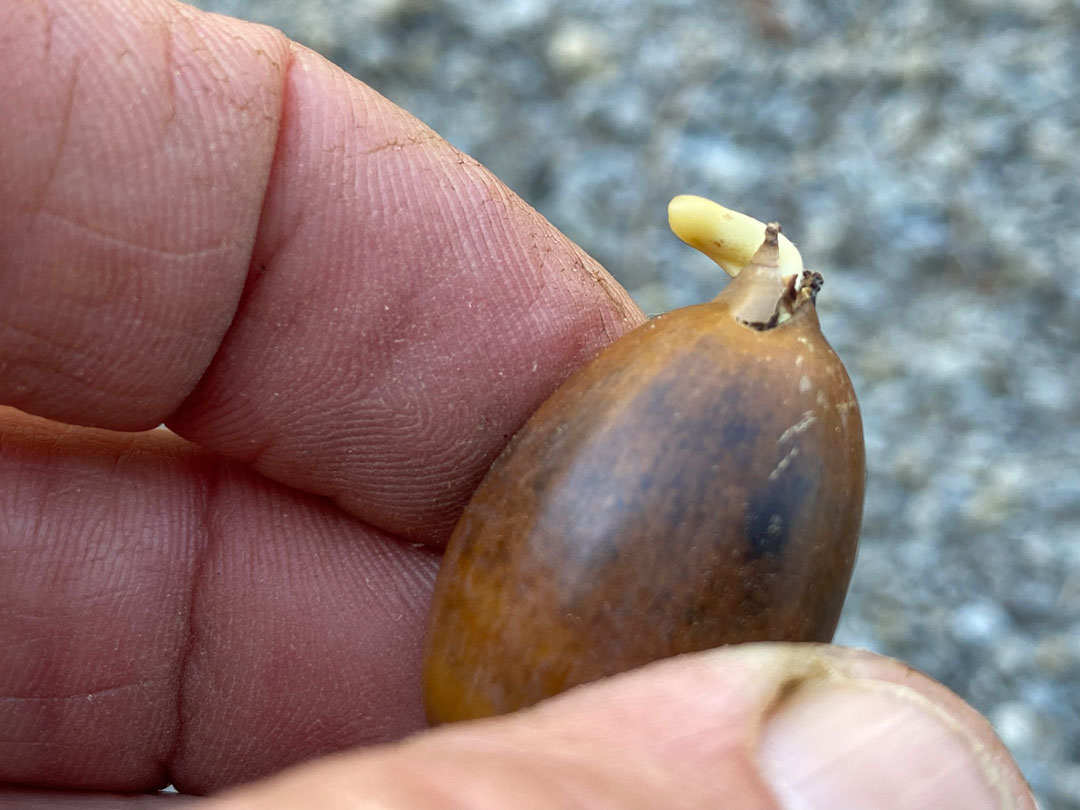
A white oak acorn sprouting a root in the fall. The “business end” of the acorn (the end with the embryo) is the pointy part. Squirrels, knowing that white oak acorns will sprout, will chew the embryo off the acorn before caching the acorn in the ground. | Photo by Jason Neumann
Acorns are food for wildlife…and the oak trees they grow into are the king of trees.
Most people grow up learning that squirrels eat and bury acorns. Squirrels, as well as other creatures like blue jays, chipmunks, and mice, bury acorns and wait until enough rainwater has dripped through the acorns to leach out some of the tannins. Some animals eat other foods to help buffer the negative effects of tannins.
Two halves of a gnawed acorn. | Photo by Jason Neumann
Mice will eat the less tannin-rich bottom part of the acorn, leaving the more tannin-rich pointy end (with the embryo) behind. Curiously, studies have shown that bottom-chewed pin oak acorns sprout even better than intact acorns.
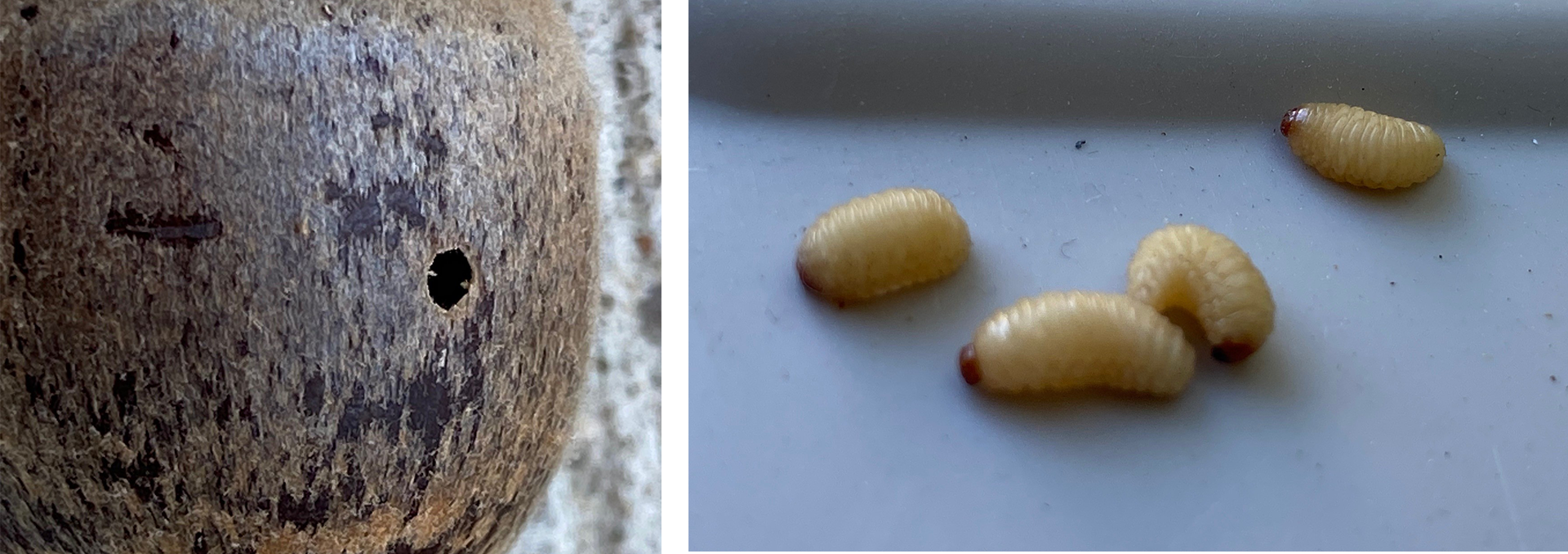
(Left) An acorn with an open hole: evidence of an acorn weevil hole. (Right) Acorn weevil grubs | Photos by Jason Neumann
There are a number of insects that make use of acorns, notably the acorn weevil (Curculio glandium), a type of beetle. Adults lay eggs in young, green acorns. The weevil grubs hatch and eat the nut meat in the safety of the acorn shell. The acorn’s fall to the ground is the weevil’s cue to chew a hole in the shell, squeeze its pudgy body out, and over winter in the ground before they turn into adult beetles and repeat the cycle the following spring.
Inside of acorn that’s been eaten (left) with untouched acorn meat (right) for comparison. | Photo by Jason Neumann
Unlike mammals that contend with protective tannins by limiting how much they eat or waiting until tannins leach out, insects, like the acorn weevil survive tannin-rich diets by using specialized gut adaptations that prevent tannins from causing toxicity. In the insect world, tannins are fairly easy to overcome…and that’s likely why oaks at the number one host plant for caterpillars.
All plants have chemicals in them to limit how much of them insects eat. Over millennia of evolution, some insect species have overcome those chemical defenses and now specialize in eating that plant. This is a host plant relationship. Monarch butterflies and milkweed plants are an example.
Oaks boast more than 550 species of caterpillars (mostly moth caterpillars) that eat oak leaves. Oaks also support upwards of 1000 species of gall-forming insects. No other group of trees in north America comes close to this diversity…hence oaks’ moniker “king of trees.” The more insect species around, the more food for insect-eating animals. As Dr. Doug Tallamy, the leading voice for native trees and shrubs as host plants says, caterpillars are the “hotdogs of the bird world,” they’re soft, protein and fat-filled tubes that kids (baby birds) love to eat paired with the advice “if you have the space in your yard, plant an oak.”
Acorns are food for us…and a lesson on moderation.
Humans have indirectly nourished ourselves on meat from animals that eat acorns. While fancy Spanish wild acorn-fed ham might come to mind, we also have a local story. Cincinnati’s alternate name of “Porkopolis” has a tie to acorns. Back in Cincinnati’s heyday as a pork processing town, regional farmers turned their hogs into the woods to allow them to fatten up on acorns and other forest nuts in the fall. In some areas, those nuts were so important the value of land was based on how many productive nut-producing trees were on it.
Hogs were herded into Cincinnati in late autumn for processing into meat…and that yielded a whole lot of pig fat. Enter in Proctor & Gamble and the start of their soap making industry.
Globally, the acorn story goes back even further. Humans have eaten and still eat acorns as food. Acorn-eating cultures have existed in Northern Africa, Middle east, the Mediterranean, Europe, Japan, Korea, China, and North America at least since the glaciers started to recede 12,000 years ago. While indigenous people in what is now Ohio were likely hickory nut cultures, the Karuk people (in what is now northern California into Oregon) have more than 90 words related to acorns referring to every intricacy of gathering, tending, processing, cooking of this staple nut.
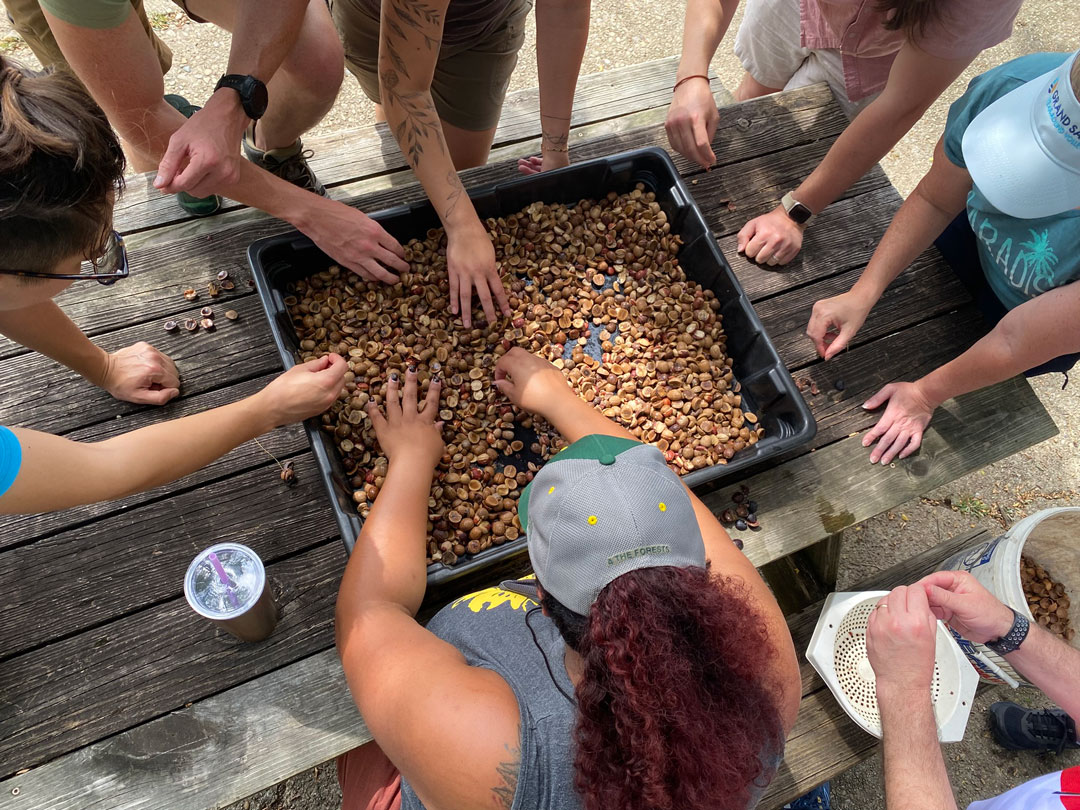
At Cincinnati Nature Center, we continue the tradition by exploring the culinary traditions of acorns through our programs. Participants are involved with all the steps from cracking to cooking, all while exploring some of the ecological lessons acorns provide.
Acorn class attendees sort shells out of cracked acorns. | Photo by Jason Neumann
Lesson #1: Grab the good acorns when you can.
The wildlife will quickly consume or cache the good acorns. Remember the “nut rule:” good, viable nuts will fall cleanly from the cap or husk. (The preschool “look what I found” acorn image from the earlier in the article was great for exploration but was not a viable nut). This advice applies whether you’re gathering acorns for propagation or food.
Remember the “nut rule:” good, viable nuts will fall cleanly from the cap or husk. | Photo by Jason Neumann
100 pounds (not kidding) of acorns in the author’s office thanks to a helpful volunteer. (Remember those pudgy acorn weevil grubs mentioned earlier? There might be a few of those crawling around on the floor). | Photo by Jason Neumann
Lesson 2: Acorns can teach us about moderation.
Tannins, those natural plant compounds that create a dry, bitter, or astringent taste in your mouth, are good for us in low amounts. Think tannins in black and green tea, coffee, dark chocolate, red wine, and some fruits. In the right amount, tannins help fight cell damage, reduce swelling, and support gut flora. In excess, tannins behave like an anti-nutrient, preventing the body from absorbing iron and causing stomach upset…which is a clear cue from nature to stop eating.
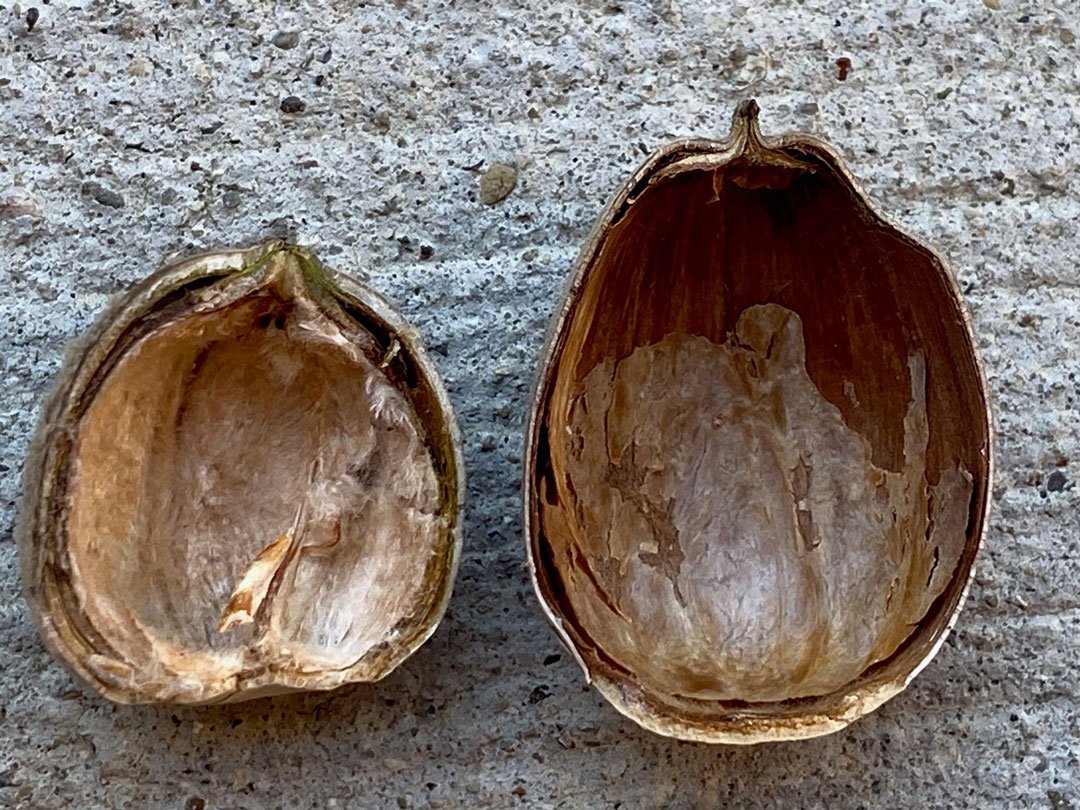
In our acorn classes, participants learn how to leach tannins out of acorns to create nourishing food for us. Since red oaks have more tannins and require more leaching than white oaks, it’s always good to know what you have by identifying the species of tree. If you didn’t identify the tree by its leaves, the lining inside acorn shells (the testa -- think the protective skin on peanuts) can tell you red vs white.
Red oak with fuzzy testa (left) vs. white oak with smooth testa (right). | Photo by Jason Neumann
As I hold this year’s bur oak acorns in my hand, they still seem almost as big as my hand. Reflecting, the side trip was an act of gratitude for the inspiration an acorn offered 50 years ago. Whether you’re exploring acorns with a child under your care, exploring the natural history related to acorns and oak trees, gathering acorns for food, or planting oaks for wildlife, you’re answering nature’s invitation to participate.
Note: Foraging at Cincinnati Nature Center is limited to staff-led programs. Please do not collect on our sites.